Friday, July 15, 2011

July 15 - Sensory Overload

I often tell my students to write using a lot of imagery;  I remind them to tap into all five senses.  Today visits to a coffee plantation and the village of Xico tapped into all of my senses.  
What did I notice? 
El Cafe-tal Coffee Plantation - There is a part of me that wants to run away and beg my new friends at this coffee plantation to give me a job.  Everything about El Cafe-tal feels warm and welcoming. We walked into the rushing smell of coffee beans and soon found a small, warm cup in our own hands.  No sugar required for this coffee.  We sat on potato-style filled sacks among the coffee plants and learned about the process of turning the little red beans from the plants into coffee.  Our guides explained how the plantation prides itself on quality over quantity, focusing on environmentally friendly growing practices and quality of plants as we walked through each stage of the process.  We chewed on some freshly roasted coffee beans and lingered with our second cup of coffee, noticing the sweet and rich flavors.  We were then led to a small studio between the green plants and coffee roasters.  There, one of our guides, Fernando, sat down to a grand piano to play some Chopin, Debussy, and some of his own compositions for us.  I left with a lot of coffee and a feeling of contentment about being at a place where the people were so genuine and kind.  


It was also discovered that Christina W. and I both shop at REI,
we have been wearing the same skirt, and we have the same bag.  

Xico, celebrating festivities of the local patron, Saint Maria Magdalena - Our evening took us to Xico where our bus could barely fit under the decorations that ran from building to building across the streets.  The community is in the midst of a ten day celebration of the Saint Maria Magdalena.  Each night neighborhoods from within the community come together to celebrate with incense, a procession, and fireworks. We walked under the brightly colored streamers up a hill to a large church with the same bright colors.    Outside of the church, a band began to play.  Young boys with cowbells tied around their wastes began to dance.  Soon, different groups of young men were hoisting floats into the air.  Each float contained the town symbol of the bull, fireworks attached to it, and various decorations.  One young man would wear the large box on his shoulders and spin in a circle while his friends would gather around cheering.  The doors of the church opened and a new group of people joined the crowd.  Candle and incense holders walked out of the church first, followed by a group of young girls carrying the Saint on a mini-float, followed by a mariachi band.  The bull floats let out a shout and made their way into the streets while still spinning. The rest of the processional and all of the crowd melted into the celebration.  We joined the processional through the streets.  We walked past food vendors and more musicians.  The music of trumpets, violins, and guitars mixed in with cowbells jingling and shouts from people.  The incense floated just above the group filling the air with a fog.  As we made our way down the streets, people stood on patios and stuck their heads out of their windows.  We swayed with the group until it made its way into another church to rest the saint until tomorrow night. 


July 14 - Passing Time

Today we made our way from Veracruz to Xalapa.  On the way, we stopped in the small town of Antigua to see the first landing spot of Hernan Cortez, Spanish conquistador in the early 1500s.  Once we arrived in Xalapa we visited the Museum of Anthropology. 
What did I notice? 
Antigua’s unintentional, historical treehouse = We arrived at the port where Hernan Cortez first arrived in Mexico.  Soon after Cortez’s arrival, the check-in point for materials and people moved to another site.  In this original spot, the trees have remained stronger than the buildings of the port.  Parts of the buildings still stand, including window frames to peek through and half walls to climb over.  While time has caused the walls to crumble, the trees have grown into and around the building, taking it over.  The roots stretch up and out of the ground to hug the deteriorating walls.  Glimpses of the choral used to make the original building appear between branches.  


The Anthropology Museum - Our afternoon brought us face to face with the great stone Olmec heads which were probably created between the years 300 and 900.  The space of the museum is an open floor with artifacts comfortably spaced out in chronological order.  The museum stretched to outdoor gardens containing more of the statues.  As we walked through the museum, I couldn’t help but think of all of the characters we passed in the stone faces.  I’m sure I passed a Bart Simpson look-alike and Fiona of Shrek face.


whispering to an Olmec head


What connections can I make?
Storytelling - I get caught up in thinking about what kind of character the real Hernan Cortez was and who these different stone figures really are.  I would love to ask my students to sit in the historical treehouse and write a story about what they think would happen, or have them plop down next to one of the Olmec statues and give a story ot that character.  

Wednesday, July 13, 2011

July 13 - Taking Veracruz Time

I think most people would agree that the pace of American life tends to be pretty fast.  People who know me would probably say I’m very good at filling my schedule and pretty terrible at down time.  In his book, The Geography of Bliss, Eric Weiner points out the benefits of taking life at a slower pace than is typical in America.  So, I’m trying to embrace the pace of Mexico.  
What have I noticed?
Yesterday we stopped at Tlacotalpan for lunch and time to “explore the city”.  Tlacotalpan is a small city on the Papaloapan river.  It is also a quiet city, without a lot of traffic, few street vendors, and little commotion.  There was not a pyramid or mountain to climb.  There wasn’t a huge variety of places to eat.  While I tend to be optimistic about new places, I did wonder what we would do to maximize the three hours from our busy schedule in this town.  So, a few of us started to stroll.  We slowly walked  through the streets and noticed the buildings.  Though there was little traffic, the streets had personality.  Bright color combinations changed with each new set of pillars.  Rod iron decorated doors and shielded windows.  Two horses waited, unattended or tied up in front of a pale blue church in the city square.  This could be the setting for a story and we had a couple of hours to absorb it. 
Today was a rainy day in Veracruz.  We started our day by picking up a teacher and some of her students to go on a tour of the Fortress of San Juan de Ulua.  After the tour, we made our way to have lunch together.  It was a Veracruz paced lunch.  We sat down and waited for our drink orders to be taken.  Then, we waited for our lunch orders to be taken.  I ate all of the chips.  I waited some more.  Our lunch came and we ate slowly.  We waited for coffee orders to be taken.  I might try to blame my impatience on being trained to eat lunch, help students, and check my email in 25 minutes throughout the school year or the fact that I get really hungry a lot.  Whatever the reason, I think I can learn a little from Veracruz time.  I was sitting next to a fifteen year-old girl from a public school in the area. She told me about what she thinks makes a good teacher, how she would like to improve school, and what she wants to do after high school.  We talked about the challenges that students face and how she was a little nervous about meeting us.  She let me practice my Spanish and she practiced her English.  Our lunch was a pretty good use of my time.   


July 12 - My Favorite Things...About the Comida

Today we spent around eight hours on the bus to take us to Veracruz.  In order to pass some of the time one of the things that our section of the bus talked about was our favorite foods from our trip, thus far.  Since nothing else too exciting happened today, I thought I would share a few of my favorite food factors. 

So, what have I noticed about the food?
#1 - The schedule:  We eat a huge breakfast around 8:30.  Then we eat a big lunch around 2:00 in the afternoon.  Around 8:00 p.m. I usually have a snack, something sweet, or a super light dinner.  I love it. 
# 2 - The service - There are always purse trees to hang bags and coats on.  If there isn’t one at your table, a waiter brings you one.  The moment a dirty plate is empty, it is removed from the table.  If a fly lands in your lemonade, a new one replaces it before you even realize it’s there.  
# 3 - The coffee (cafe con leche) - Waiters are always ready with coffee in one hand and warm milk in another.  Tonight we went to a cafe where the waiters poor the milk two feet above the coffee into the cup and don’t miss a drop. 
# 4 - Warm Tortillas - Need I say more? 
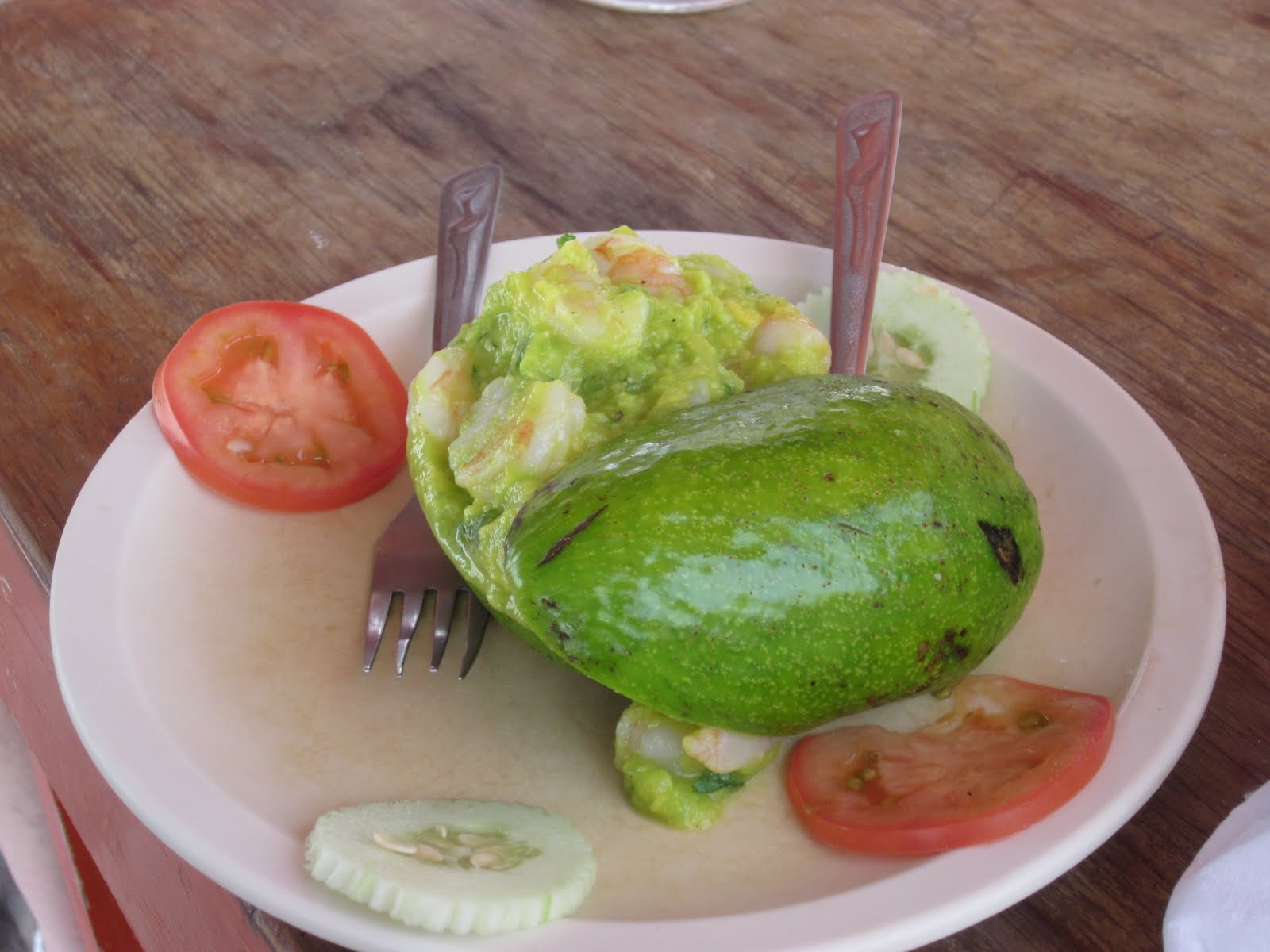
# 5 - Lime and Avocados- Lime and avocado come with everything and everything is better with lime and avocados: chips, bread, soup, enchiladas, vegetables, fish 
# 6- Pan Dulce (Sweet Bread) - I admit to missing wheat bread with peanut butter, but I love that every breakfast offers a variety of sweet breads: chocolate filled, sugar coated, warm sweet bread


fresh tortillas

Pan Dulce

Avocado stuffed with shrimp

Cafe con leche

We're always greeted with fresh squeezed juice

Answering Questions:
While on the bus I was also thinking about some of the questions I've had throughout this trip.  A few days ago I was wondering about how the people in Chamula adopted some religious influences, but not others.  I realized that they didn't really adopt any other form of religion.  They worship in a church that has some Catholic influences, but the way that they worship is completely separate from the building that they are in.  

Monday, July 11, 2011

July 11 - Another View


I was sad to leave San Cristobal this morning, but I did get one more run through the city.  When we left our hotel for a run, a dog quickly started trotting by our side and stayed with us all the way through town, up the steep stairs to the cathedral,and all the way back to our hotel.  I’m glad I’m leaving a friend in one of my new favorite cities. 

Our group loaded the bus to learn about marimbas (music = one of my favorite things) and to see the views of the Canon del Sumidero (nature = another one of my favorite things).  
What did I observe today?
Our first stop today was a marimba workshop with the Nandyapa family.  We learned about the history of the marimba in Mexico, the detailed process of how it is made, and I  volunteered to play a part in a waltz.  The view of mountains and a river from the workshop space made me consider taking up the marimba professionally, but I think my skill level will require me to keep teaching.
We experienced the views of the Canon del Sumidero from below via boat and above via a lookout point.  As our boat made it’s way down the Canyon, we tilted our heads upward to see the tops of the towering rocks on either side of us.  I felt small as we moved down the canyon and the walls of rock seemed to keep growing higher around us.  We passed our share of herons, vultures, and a crocodile perched on the shore.  Scanning the stone, we spotted waterfalls trickling down, deep caves, and even a shrine to one of the Saints.  Unfortunately, clusters of plastic bottles are scattered throughout the Canyon, though there are many signs that talk about a clean canyon project.  An unexpected rain shower added an adventure feel to our ride.  
When our bus took us to the top of the canyon, I was pleasantly surprised to see an equally incredible view.  As we looked over the edge to the wall scaling down into the Canyon, we were reminded of the Chiapas who hurled themselves to death into the Canyon rather than being taken captive by the Spaniards in 1528.  
Canyon from below

Canyon from Above


Canyon from above


Sunday, July 10, 2011

July 10 - Looking for God

Within Chiapas there are several indigenous communities that live with their own language and traditions.  Today we went to San Juan Chamula and Zinacantan, both Tzotzil groups.  
What did I observe?
San Juan Chamula is a small town outside of San Cristobal.  We walked into the city square to see tents filling the space with fruits, coffee beans, corn, and fabric.  The people sitting in front of each stand speak enough Spanish to try to sell items to the tourists walking through.  A row of church leaders covered in black wool vests over white shirts sit at one end of the town square.  We were not allowed to take pictures of any of the community leaders.  
We were also not allowed to take pictures inside the church that is center to the Chamula community.  The mixture of indigenous faith practices and the Catholic influence create a stimulating scene in the walls of the church.  
The outside of the church looks like many churches.  It had large, double front doors opening into the sanctuary.  The top of the white building had a cross on top.  Inside, the church was like no other place of worship I have experienced.  There were no pews or even chairs.  The walls on both sides of the church were covered with human-like saints enclosed in cases like many Catholic churches.  The difference was that the saints covered all of both walls.  Each saint was holding a mirror facing out.  Large flowered fabric strips hung from one side of the sanctuary to the peak of the church, to the other side at five different places.  The floor was made of ceramic tiles covered in pine needles.  Every few steps a circular area was cleared of pine needles so that people could light rows of candles in that circle.  It smelled like Christmas.  Groups of people sat around the little shrines throughout the church burning candles and incense.  Some people were moving eggs across their bodies, a way to remove bad spirits, while other people held live chickens which were going to be sacrificed.  Others were drinking bottles of coke.  It is believed that when you burp, the bad spirits are leaving so coke is often a great way to get rid of the bad spirits.  The front of the sanctuary had a more typical feel to it: John the Baptist was at the front of the church and flowers filled the space in front.  This is the worship service - people kneeling by candles and praying while tourists squeeze their way through to watch.  

Market in San Juan Chamula

What questions do I have?
I was inspired by the traditions in the communities we visited, but was also left with a lot of questions.  The Chamula community is a peaceful community where people take care of each other.  Unique weaving and sewing of fabric, language, and other traditions have continued to be passed down from one generation to the next.  It is powerful to see a group of people who are able to hold onto their customs when another group of people tries to impose their own culture on them.  However, I found myself wrestling with the common question: When does the value of tradition and culture outweigh the value of individual rights?  People who have chosen to break away from the Mestizo Catholicism have been exiled from the community and forced to live on the edges of San Cristobal.  When I asked about people who didn’t want to wear the traditional symbols of the Chamula, I was told that most people just did want to wear them.  When I asked about the women’s roles in the church and community I was told that they were treated equally.  When I pointed out that all of the leaders of the community (who are the leaders of the church) are men and that only men can vote, I was told that it’s ok because the men talk to their wives about the way they vote.  I’m skeptical of the situation, but I’m also skeptical of my own perspective because I have only visited the community for one day.  I recognize how little I know.  
What connections did I make? 

It seems to me that Liberation theology would be an ideal religious match for the Zapatista movement that occurred in many of the indigenous communities surrounding San Cristobal.  I think that my own admiration of liberation theology is probably getting in the way of my understanding of this other form of religion.  
As an educator, one of my goals is to encourage my students to question the things that are simply expected of us.  At the same time, I’m also always trying to get my students to think about the other perspectives in a situation.  I was struggling with both of these ideas today.  

Weaving in Zinacantan


July 9 - Talking about a Revolution

If Minneapolis can be ranked the # 1 hipster city in America, I think San Cristobal could be the most hipster place in Mexico.  
What have I observed? 
This morning, Kate and I had a quiet run through the city, passing numerous coffee shops and bakeries.  The fog was rolling in over the mountains surrounding the city and bells were tolling from churches lining the city square.  It is a beautiful place to run.  By this afternoon the city was full of locals selling textiles and jade on the city square and the pedestrian walking street that cuts through town. Tourists sporting backpacks, Keens, and bikes seem to flock to this site of the1994 Zapatista Revolution.   This evening we walked past the zocolo to find a rock band playing in one corner, a traditional Mayan dance being performing in another, and large canvas art being created in a third area.  We walked into a bar called Revolucion to find pictures of Che and Marcos on the walls.  A band covered Bob Marley and the tables filled with conversations in German, French, and Italian.   
Different places we went and lectures we attended today reminded me that blocks away from this celebration of revolution are neighborhoods full of people who are still pushed out of the center of this city.  We attended lectures about migration trends in Mexico, the history of the Zapatistas, and the changes in textiles of different indigenous cultural groups in Chiapas. 


The city center in San Cristobal


What questions do I have?
It’s clear that the Zapatista movement brought the attention of the needs of many people to the government, requesting more school, roads, and equal treatment.  As disparities still exist, I can’t help but wonder where the appearance of the Zapatistas are now.  I also find myself wondering if the international zest for the Zapatista is stronger than the energy within Mexico right now.  


Today we listened to an interesting lecture about the changing clothing of the different Mayan cultural groups throughout Chiapas.  I am glad that this tradition is being documented, but I want to hear more of it from the voice of the women who wear and this clothing.  I always wonder how the perspective of the narrator changes the voice of the story.  


Fulbrighters, Trina, Alejandro, and I with one of our guest speakers


A shop that makes recycled paper in San Cristobal